
 By
By 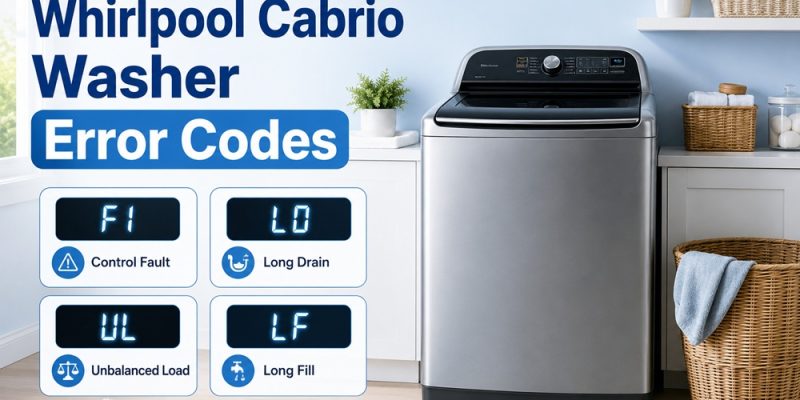
Quick answer: Whirlpool Cabrio washer error codes point to one failed part or condition. The most common are uL/F0 E5 (unbalanced load), F5 E2 (lid lock failure), LF/F30 (long fill, water not entering fast enough), LD/F32 (long drain, water not leaving fast enough), and F51 (motor rotor position sensor). On models without a digital screen, the same faults show up as a blinking lid-lock light. Start by unplugging the washer for one minute to reset it, then match your code below.
Cabrio washers flash a code when the control board detects a component failure. Some models show it on a digital display. Many do not, and instead blink the status lights, so you decode the pattern from the tech sheet inside the machine.
How do I read a Cabrio error code?
The code has two parts. The F number identifies the system (motor, control, water valve). The E number pinpoints the specific fault within it. Letter codes like LF, LD, and uL are plain-language versions of the same faults on newer models.
Before anything else, do the universal first step: unplug the washer for 60 seconds, then restart. A surprising number of one-time glitches clear with a full power reset.
Whirlpool Cabrio error code chart
| Code | Meaning | Most likely fix |
|---|---|---|
| uL / F0 E5 | Unbalanced load | Redistribute clothes evenly, remove a few items, run drain/spin |
| oL / F0 E3 | Overload, too much laundry for the tub | Remove some items and restart |
| F0 E2 / Sud / Sd | Excessive suds or too much drag on the basket | Use less detergent, switch to HE detergent, run a rinse |
| LF / F30 | Long fill, tub filling too slowly | Check inlet screens and supply hoses, confirm both taps are open |
| Lo / low pressure | Water level or pressure too low | Clean inlet screens on the fill hoses |
| LD / F32 | Long drain, water leaving too slowly | Clear the drain pump filter and hose, check for a clog |
| dL / F5 E1 | Lid will not lock | Clear obstructions, inspect the lid lock striker |
| F5 E2 | Lid lock failure (locked but not sensed) | Replace the lid lock assembly |
| F5 E3 | Lid lock/latch fault with clicking | Inspect latch and striker, then the lock assembly |
| LID | Cycle started with the lid up | Close the lid and restart |
| PO | Pump out, lid open over 10 minutes with water in tub | Close lid, let it pump out |
| F1 E2 | Communication error, control board to motor | Check the wiring harness for loose or damaged connections |
| F7 E1 | Loss of power during the spin cycle | Reset power, inspect the control board if it repeats |
| F40 | ATC thermistor open or shorted (on the water valve) | Test and replace the thermistor |
| F50 / F51 | Motor rotor position sensor (RPS) fault | Check for an item stuck under the tub, clean the drive shaft, then replace the sensor |
| F1 | Bad signal from the water level pressure switch | Inspect the pressure switch circuit |
Fixing the most common codes
Unbalanced load (uL or F0 E5)
This is the code you will see most. The drum cannot spin safely because the laundry is bunched on one side.
- Open the lid and spread the load evenly around the drum.
- Remove a few heavy items if the machine is packed.
- Balance a single bulky item, like a comforter, with a couple of towels.
- Restart on drain and spin.
A washer that is not level makes this code appear constantly. Check the feet with a level before assuming a part has failed.
Lid lock codes (dL, F5 E1, F5 E2)
The Cabrio will not run with the lid unlocked, so a faulty lock stops everything.
- dL / F5 E1: The lid is not locking. Check for laundry caught in the seam and inspect the striker that the latch grabs.
- F5 E2: The control cannot confirm a lock. This usually means the lid lock assembly needs replacing. It is a common, inexpensive part.
Appliance techs note a frequent pattern: owners replace the lock, the code returns, and the real culprit turns out to be the control board. If a new lock does not clear F5, the board is the next suspect.
F51 and the stuck-sock trick
F51 signals the motor rotor position sensor cannot read rotation. Before buying a sensor, try the fix that costs nothing.
A small item, often a sock or washcloth, slips under the inner tub and jams it. Lift out the inner drum and look for a trapped item. The drive shaft can also rust and cause drag, so clean it while you are in there. Many F51 cases resolve with no new parts at all.
Long fill and long drain (LF and LD)
- LF / F30: Water is not filling fast enough. Confirm both hot and cold taps are fully open, then unscrew the fill hoses and clean the little inlet screens, which clog with mineral debris.
- LD / F32: Water is not draining fast enough. Clear the drain pump filter and check the drain hose for a kink or clog. A blocked pump is the usual cause.
How do I clear a stored Cabrio error code?
Enter diagnostic mode and hold the cycle button that scrolls between stored codes for about five seconds to clear them. If a code will not clear after a repair, a simple power reset (unplug for a minute) usually lets the washer resume normal operation.
When should I call a technician?
Handle these yourself: unbalanced loads, suds, clogged screens, drain clogs, and stuck items under the tub. Call a pro when you see repeated control-board communication faults (F1 E2), a lid lock code that returns after a new lock, or any code tied to the motor or control board that persists after the basics. These need diagnostic tools and often a board replacement.
FAQ
My Cabrio has no screen. How do I see the code?
Screenless models blink the lid-lock light in a pattern. Match the pattern to the tech sheet stored inside the washer’s console or under the lid.
Is F51 always a sensor replacement?
No. Check first for an item wedged under the inner tub and clean the drive shaft. That fixes a large share of F51 cases for free.
Why does the unbalanced code keep appearing on small loads?
An unlevel machine or a single heavy item spinning alone triggers it. Level the feet and pair bulky items with a few smaller ones.
Can too much detergent cause an error?
Yes. Excess suds trigger Sud, Sd, or F0 E2. Use only HE detergent and cut the dose, then run a rinse cycle.












Comments